Thermo-Hydro-Mechanical
Processes in Porous Media

Porous geological media—rocks, soils, and deep reservoirs—experience intricate interactions between thermal energy, fluid pressure, and mechanical stresses. Explore the governing physics and run real-time simulations.

Interactive Porous Micro-Node (T-H-M Interactive)
Hover/drag to compress grains & speed up fluid flow

Physical Conception of THM

A porous medium is a multi-phase system consisting of a solid skeleton (grains) and interconnected pore spaces filled with fluids (water, gas, or oil). In deep geologic environments, three main physical processes are coupled:

  • T
    Thermal Field: Heat transfer through conduction (solid contact) and fluid convection.
  • H
    Hydraulic Field: Fluid flow through pore networks and fractures driven by pressure gradients (Darcy's Law).
  • M
    Mechanical Field: Deformations, strains, and stress fields within the skeleton, governed by effective stress constraints.

The illustration on the right showcases how these fields interact near a borehole, illustrating fluid pressure vectors, thermal isotherms, and stress concentrations.
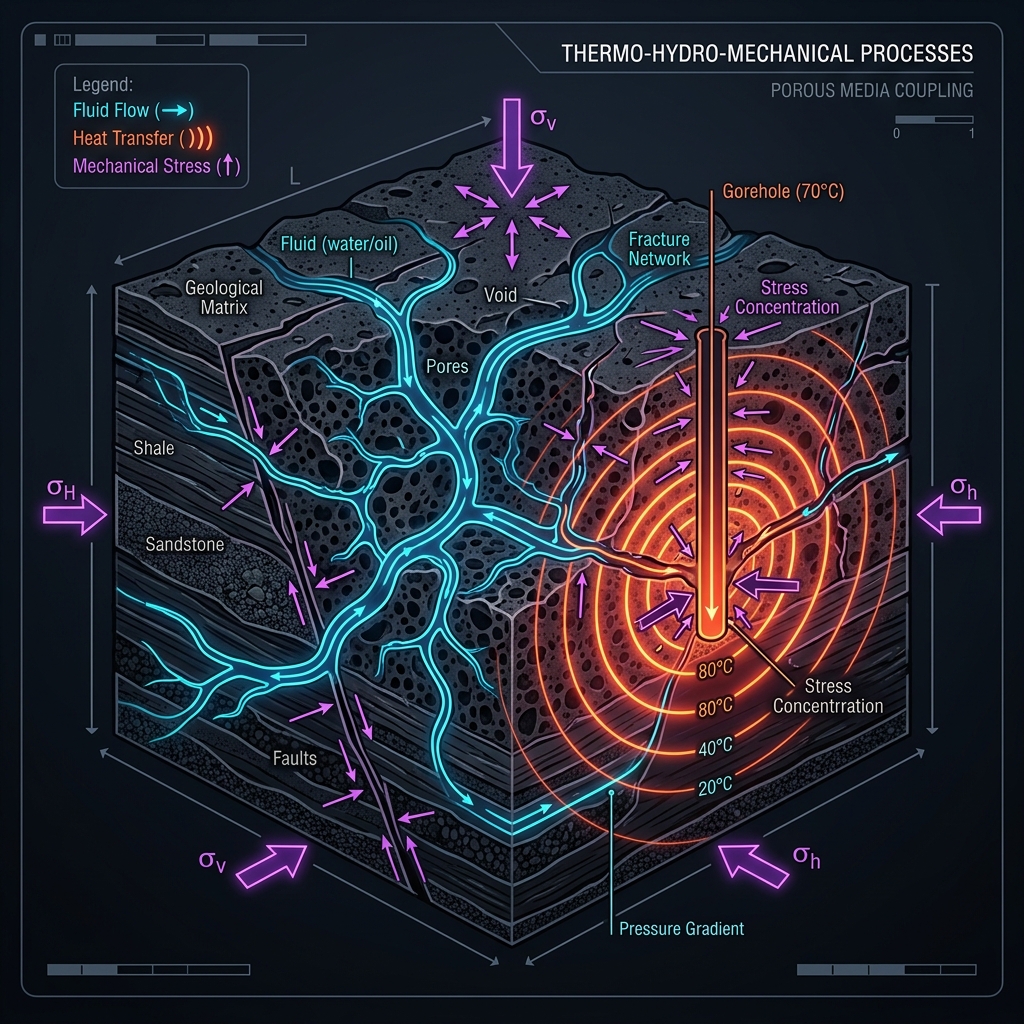
Thermo-Hydro-Mechanical geological coupling illustration

The Coupling Matrix

THM physics is defined by how each field drives, modifies, or couples with the others. Click on a coupling cell in the matrix below to reveal its mathematical relations and physical examples.

Thermal (T)
Thermal Pressurization
Thermal Stress
Convection / Advection
Hydro (H)
Effective Stress
Frictional Heating
Poroelastic Squeezing
Mechanical (M)

Select a coupling path in the matrix

Click any arrow cell (e.g., T ➔ H or H ➔ M) to view the physical mechanism and governing equation.

Interactive Simulation Lab

Simulate coupled processes under geological conditions. Adjust variables in real time to witness how mechanical consolidation, thermal heating, and fluid flows trigger physical changes.

1D Terzaghi Consolidation Column
Status

Soil Consolidation Lab

Apply load to a saturated soil column. Water escapes through the top surface, shifting load stress from fluid pore pressure to the solid grains over time.

Total Settlement
0.0 mm
Avg. Pore Pressure
100.0 kPa
1D Thermal Pressurization Grid Solver
Status

Thermal Pressurization Lab

Inject heat at the center of a low-permeability rock core. Watch temperature diffuse outwards and induce transient fluid pressure spikes before slow dissipation.

Max Pore Pressure
0.0 kPa
Max Core Temp
20.0 °C
Mohr-Coulomb Stress State
Realtime

Thermal Fracturing Lab

Observe Mohr's Circle shifts as thermal stress and pore pressure change. If the circle breaches the Mohr-Coulomb failure envelope, shear fracturing/fault activation occurs.

Eff. Major Stress (σ'₁)
50.0 MPa
Eff. Minor Stress (σ'₃)
20.0 MPa

Mathematical Formulations

Porous media THM behavior is mathematically defined by three interrelated conservation equations combined with Biot's poroelasticity theory.

Heat Energy Conservation

Governs temperature evolution through conduction (Fourier's Law) and heat advection carried by fluid motion.

$$(\rho C_p)_{eff} \frac{\partial T}{\partial t} + \rho_f C_f \mathbf{q}_f \cdot \nabla T - \nabla \cdot (\lambda_{eff} \nabla T) = Q_T$$
T Temperature
C_p Heat capacity
\mathbf{q}_f Darcy fluid flux
\lambda_{eff} Effective thermal conductivity

Fluid Mass Conservation

Balances fluid flow via Darcy's Law with compression of pore structures and thermal expansion of the fluid phase.

$$S_{\alpha} \frac{\partial p}{\partial t} + \alpha \frac{\partial \epsilon_v}{\partial t} - 3\alpha_{th} \frac{\partial T}{\partial t} - \nabla \cdot \left(\frac{k}{\mu} \nabla p\right) = Q_f$$
p Pore fluid pressure
\epsilon_v Volumetric strain
\alpha Biot coefficient
\alpha_{th} Soil thermal expansion

Mechanical Momentum Balance

Enforces force equilibrium for the porous medium. Solved in terms of stress, including pore fluid pressure and thermal stresses.

$$\nabla \cdot \boldsymbol{\sigma} + \mathbf{f} = \mathbf{0} \quad \text{with} \quad \boldsymbol{\sigma} = \boldsymbol{\sigma}' + \alpha p \mathbf{I}$$
\boldsymbol{\sigma} Total stress tensor
\boldsymbol{\sigma}' Effective stress tensor
\mathbf{f} Body forces (gravity)
\alpha p \mathbf{I} Pore pressure coupling term

Stress-Strain constitutive relationship

Poro-elastic-thermal Hooke's relation. Defines stress changes generated by combinations of strains, temperatures, and pore fluid pressures.

$$\sigma'_{ij} = C_{ijkl}\epsilon_{kl} - K \alpha_s (T - T_0)\delta_{ij}$$
C_{ijkl} Stiffness tensor
\epsilon_{kl} Elastic strain tensor
K Bulk modulus
\alpha_s Solid skeleton expansion

Real-World Applications

Analyzing THM coupling is essential for designing modern energy systems, managing resources, and predicting environmental risks.

Enhanced Geothermal Systems (EGS)

Injecting high-pressure cold water into deep, hot basement rock (HT) creates thermal stresses that trigger micro-shear failures (TM/HM), opening secondary flow paths and creating a hot water circulation loop.

Geological Nuclear Waste Disposal

Radioactive waste generates heat (T), which induces mechanical expansions (TM) and thermal pressurization of water in the clay or granite buffer barriers (TH). Analyzing this coupled state prevents canister fracturing.

CO₂ Geological Sequestration

Injecting supercritical CO₂ into saline aquifers or depleted gas fields increases pore pressure, lowering effective stress and risking fault reactivations (HM). Simultaneously, cold CO₂ in warm formations generates thermal stresses (TM).

Aquifer Drawdown & Land Subsidence

Depleting water tables from aquifers reduces pore water pressures, transferring the weight of the overburden entirely onto the soil skeleton (HM). This leads to plastic compaction of clay beds and widespread sinking of cities.