I work a lot on physics-informed neural networks (PINNs) and neural surrogates for computational geomechanics, and the hardest constraint in that work has never been the network architecture: it is the training data, because every labeled sample is itself an expensive numerical solution. So when a recent paper came along proposing a way to reduce how much labeled simulation data neural physics simulators need, by first pre-training on abundant raw geometry with synthetic dynamics and only then fine-tuning on real simulation data, Wu et al. (2026), arXiv:2602.20399, on scaling physics simulation via lifted geometric pre-training with a model named GeoPT, it immediately attracted my interest.
I digested it the way I now digest most long papers: by asking ChatGPT’s image generation skill (GPT Image 2) to turn it into a slide deck. I used to do this kind of first pass in NotebookLM (now Gemini Notebook); I find ChatGPT’s output better these days - may be until the next version of Nano Banana? The workflow is straightforward: give ChatGPT the arXiv link, ask for a deck that explains the paper intuitively, and the image skill generates the slides one by one, with no template or art direction from me. Unlike a text summary, a slide has to commit: a title, a layout, limited space. That forces the same compression a human presenter performs, and the result sticks with me in a way prose summaries never did. I posted about this on X recently; this note is the longer version, with the full deck and some thoughts on what the paper could mean for geomechanics.
The paper, in seven slides
Below is the seven-slide deck exactly as generated; use the arrows (or arrow keys, or a swipe) to move through it, with my notes on each slide underneath.
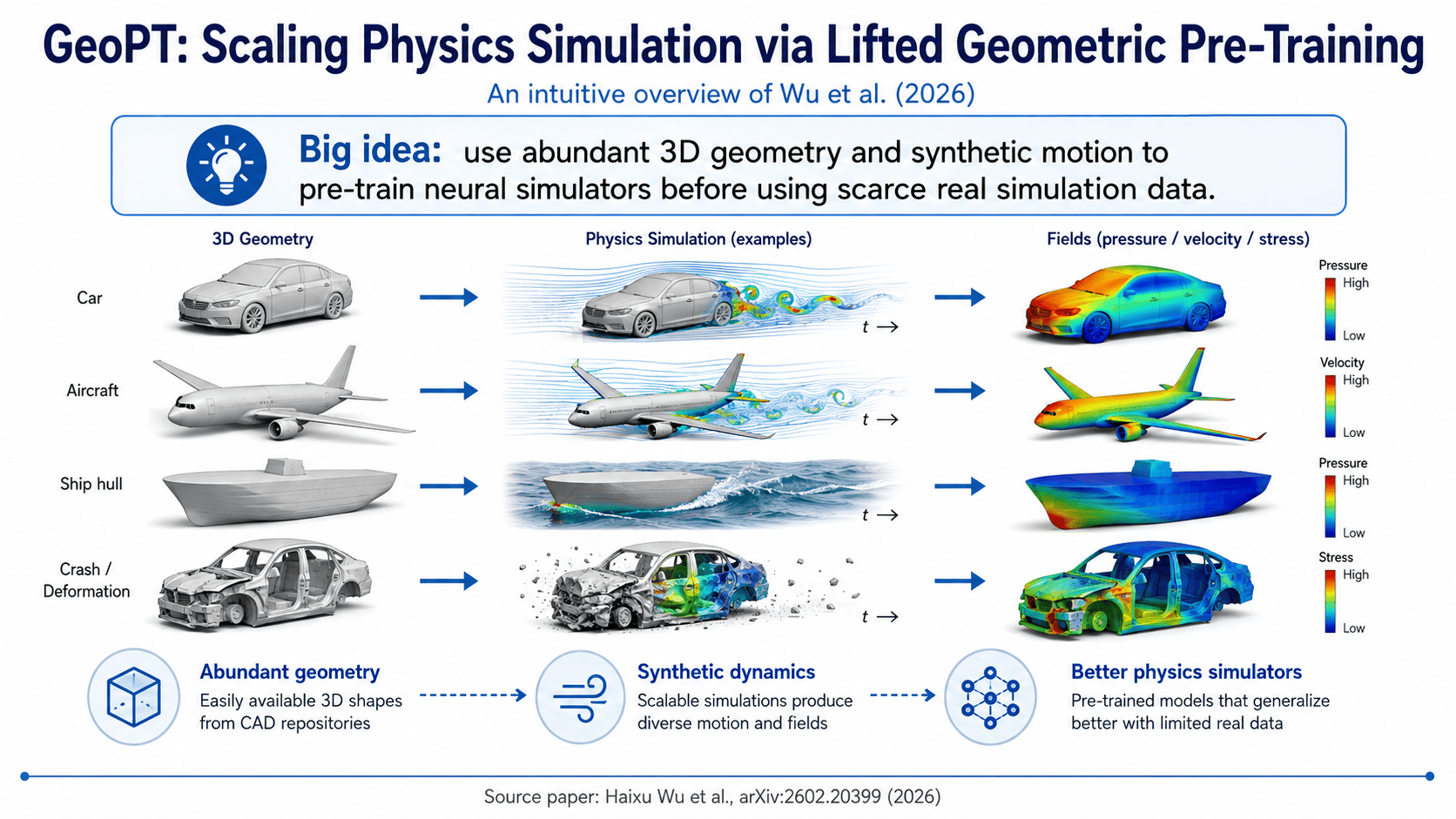
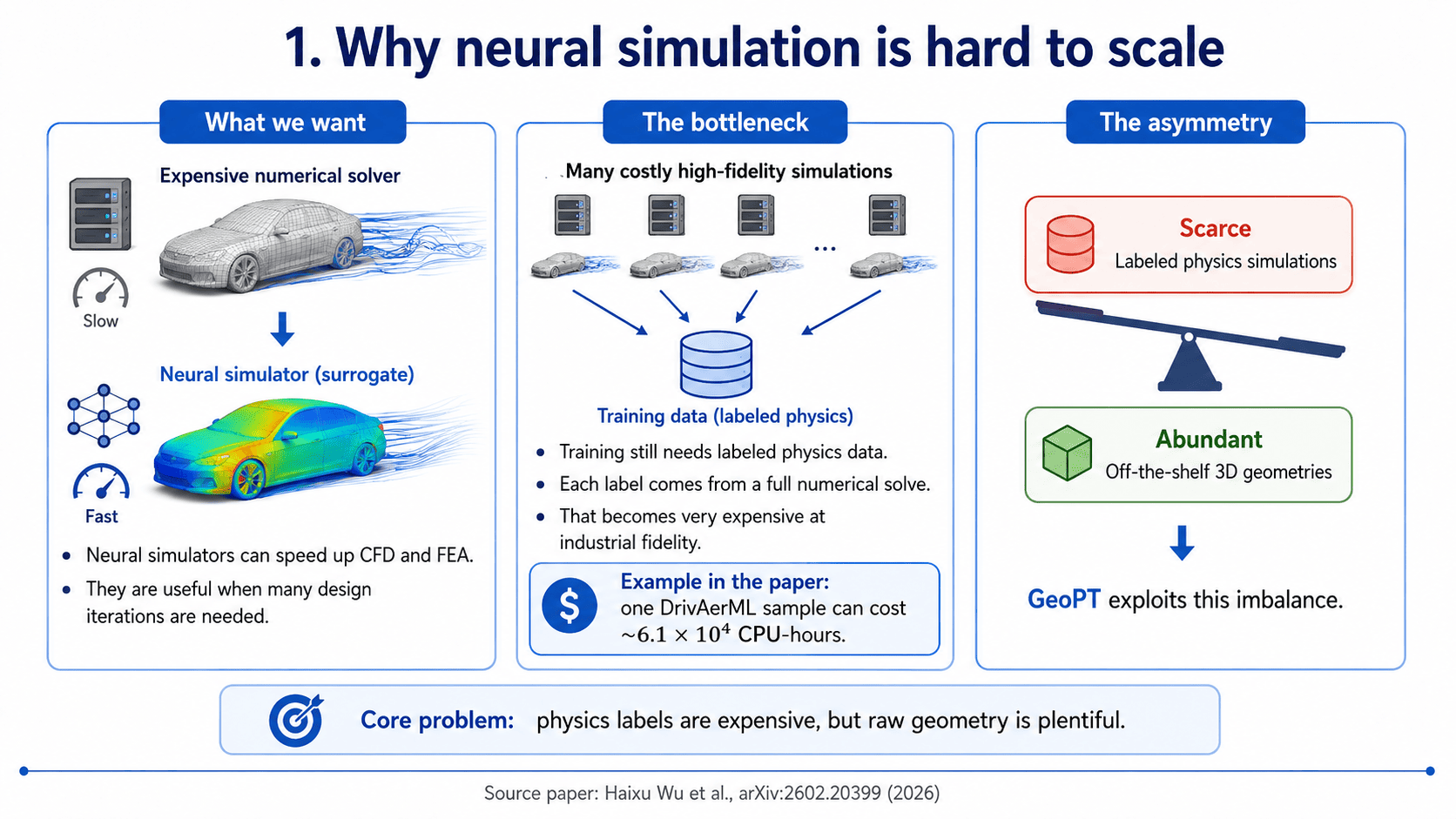
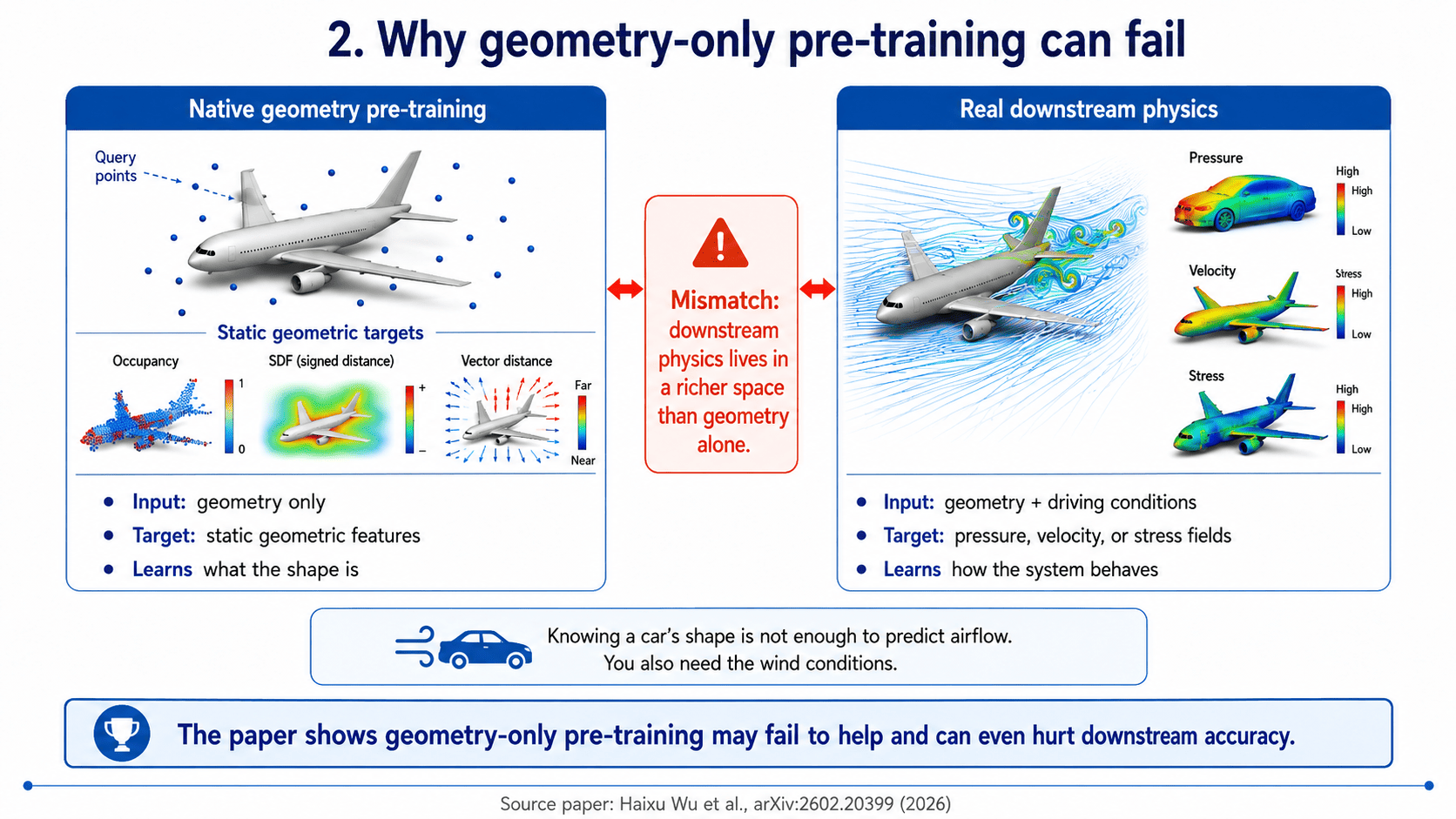
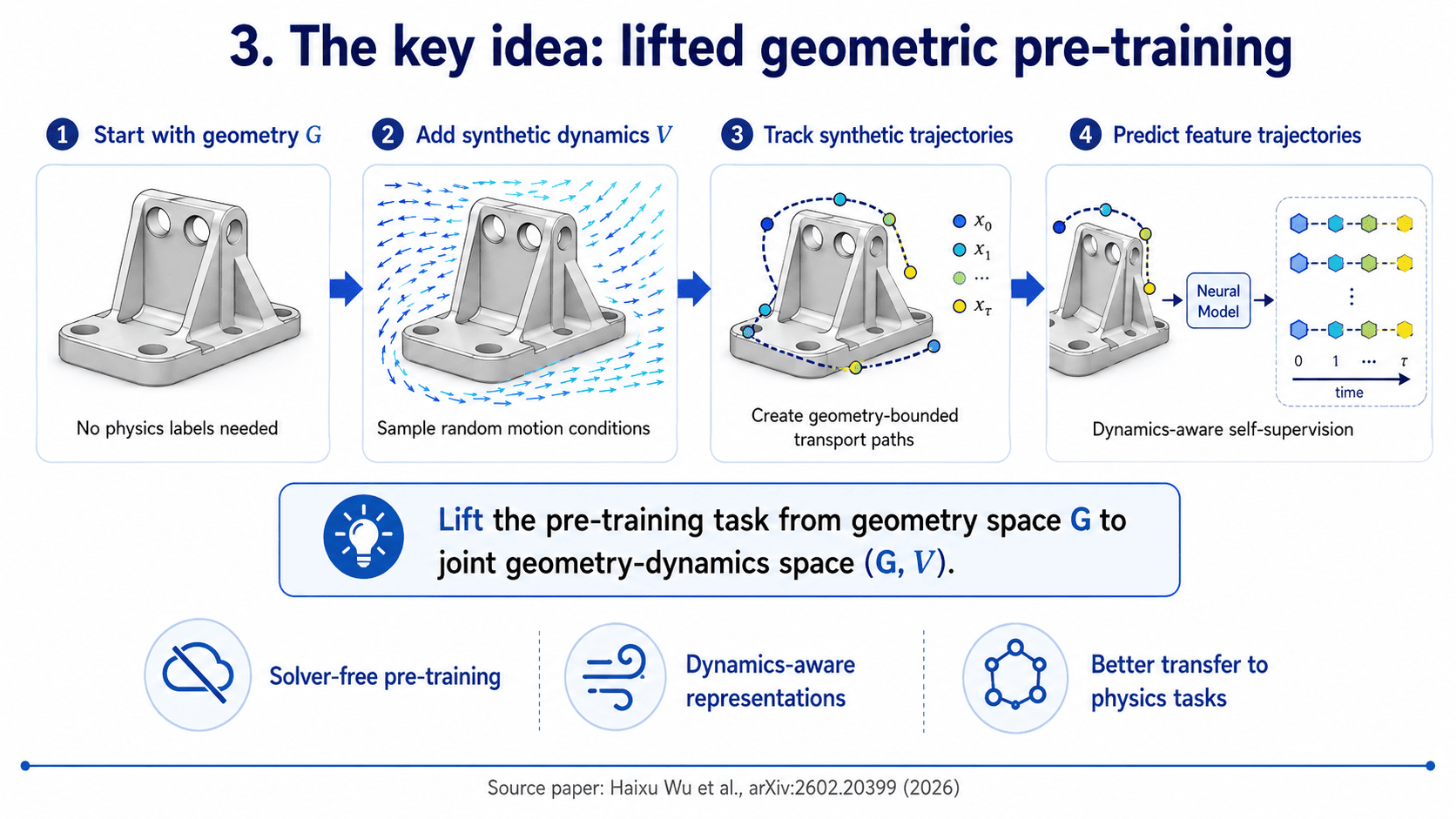
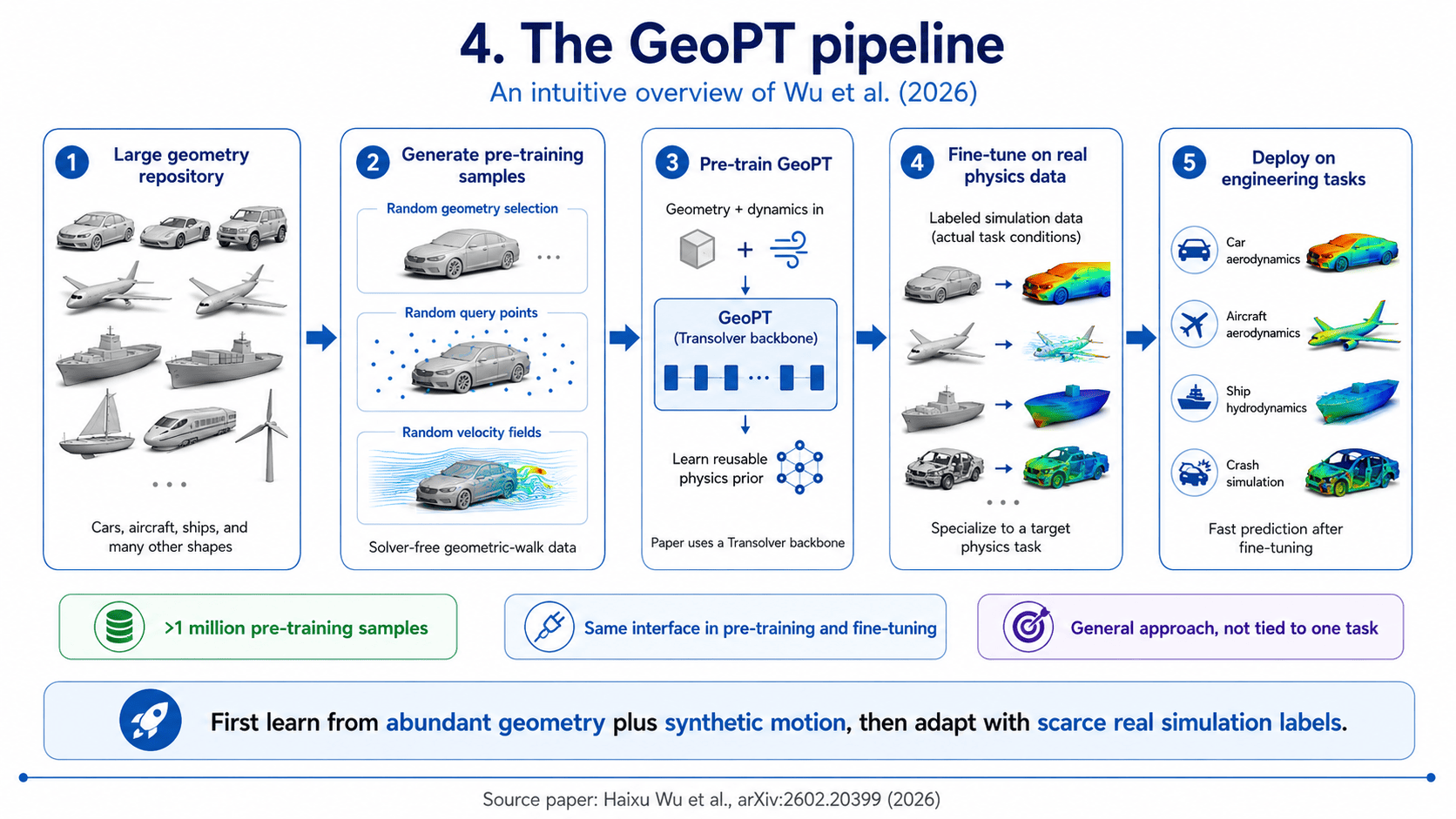
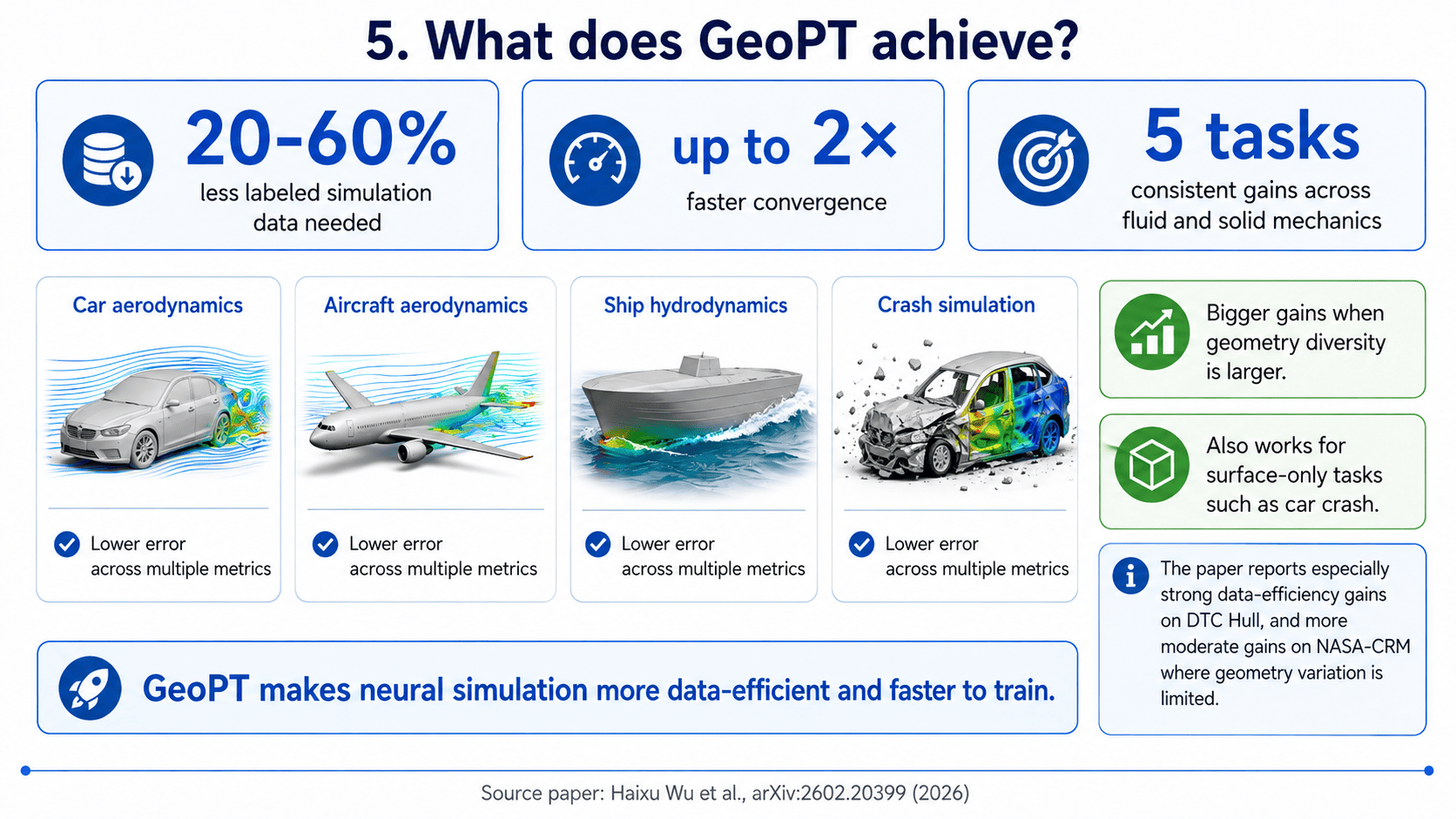
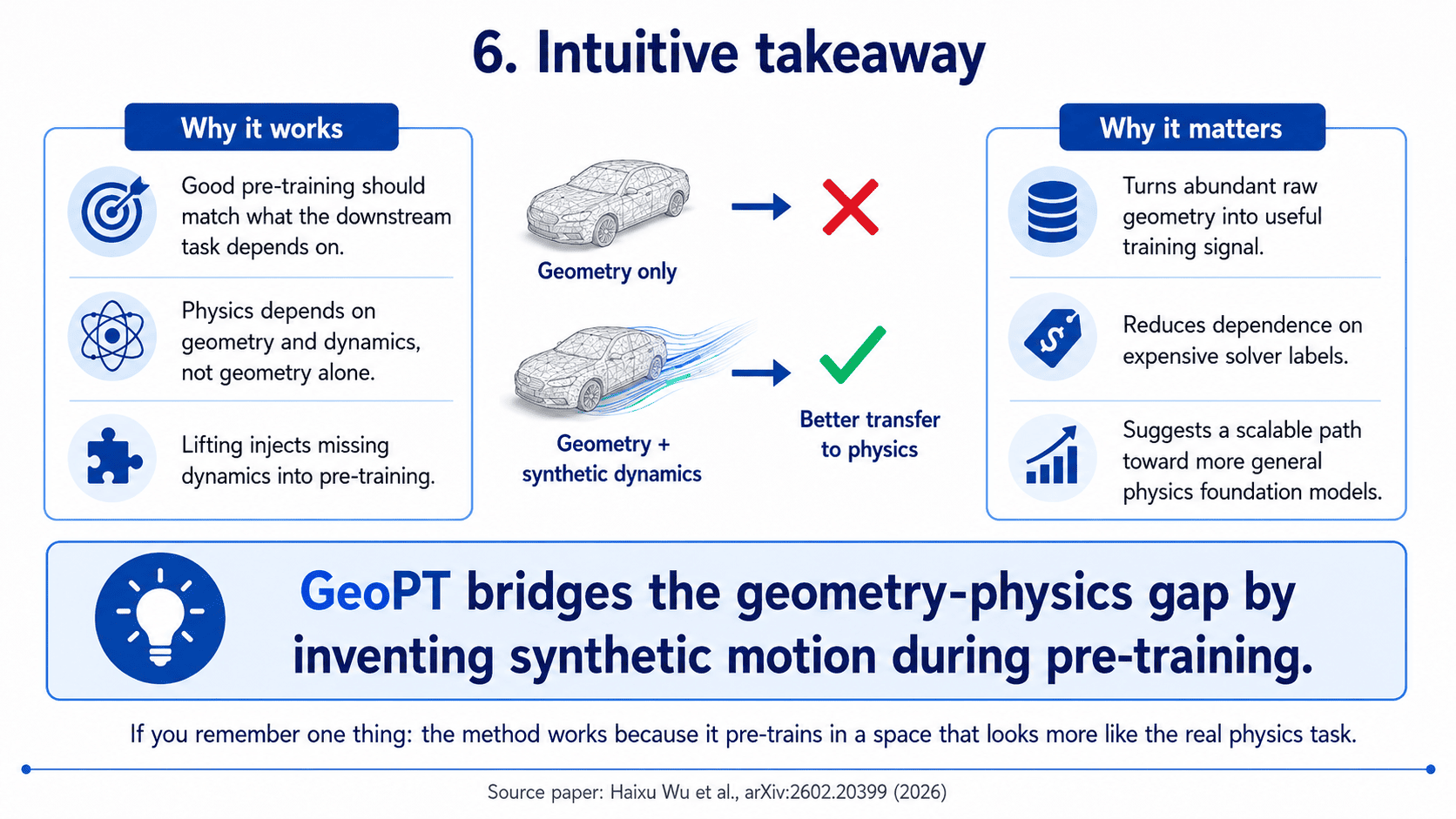
After going through the deck, I skimmed the paper to check it. I did not find a claim on the slides that the paper does not make, and reading the paper afterwards took a fraction of the usual effort because I already had the skeleton.
Relevance to simulations in geomechanics
The problem this paper attacks describes computational geomechanics well. A coupled hydro-mechanical or thermo-hydro-mechanical analysis is exactly the kind of expensive label the paper talks about: a single well-resolved 3D analysis can take hours to days, and we rarely run enough of them to assemble a training set of any size.
We also have our own version of abundant unlabeled geometry. There is no CAD repository of the subsurface, but national databases hold vast numbers of ground investigations and interpreted stratigraphy, terrain models are freely available, and design offices sit on decades of ground models, none of it with a physics solution attached.
The lifting step suggests a geomechanical analogue: take a ground model, impose random seepage fields, loading paths, or pore-pressure boundary histories without solving them, and pre-train a network to predict how features evolve, before fine-tuning on a small set of real coupled simulations. The paper’s negative result carries a warning for our field too: pre-training a subsurface model on stratigraphy alone, learning “what the ground looks like,” is the direct analogue of the geometry-only pre-training that Wu et al. show can fail. Geomaterial behaviour depends on loading and drainage history, not on the geometry of the deposit alone.
The transfer would not be easy: our geometry diversity is arguably lower than a CAD repository’s, and the paper is explicit that gains shrink when geometry variation is limited. But the structural lesson, that data-efficient surrogates come from pre-training in a space that resembles the coupled problem rather than from hoarding expensive simulation results, seems directly relevant to where geotechnical machine learning should go next.